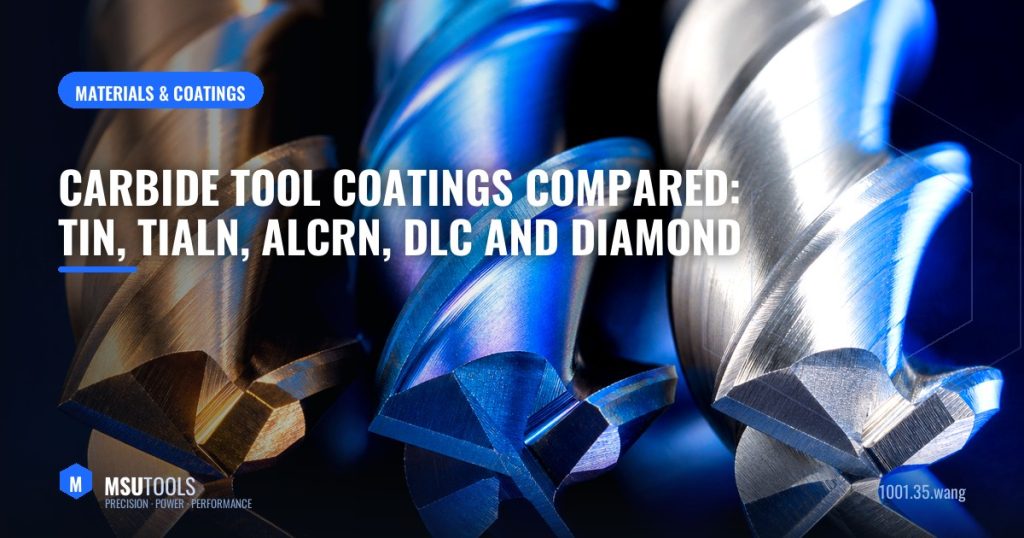
Two end mills can be ground from identical carbide and still deliver wildly different tool life. The difference is usually the coating — a layer only two to five microns thick that decides how much heat the edge tolerates, how readily chips slide away, and whether the workpiece material welds itself to the cutting edge.
Here is what the common coatings actually do, and where each belongs.
The Main Coatings at a Glance
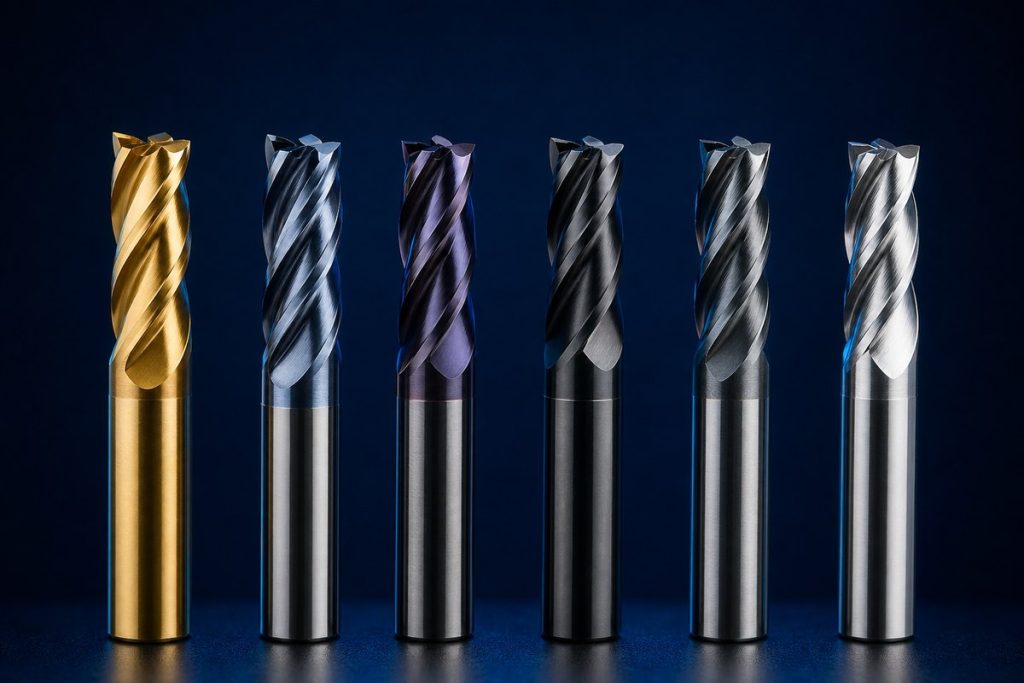
| Coating | Colour | Max working temp. | Best for |
|---|---|---|---|
| TiN | Gold | ~600 °C | General purpose, mild steel |
| TiCN | Blue-grey | ~400 °C | Abrasive materials, cast iron |
| TiAlN | Violet-black | ~800 °C | Steel, stainless, high speed / dry |
| AlTiN | Black | ~900 °C | Hardened steel, high heat |
| AlCrN | Blue-grey | ~1100 °C | Hardened steel, interrupted cuts |
| DLC | Dark grey | ~350 °C | Aluminium, copper, plastics |
| Diamond (CVD) | Grey | ~600 °C | Graphite, CFRP, ceramics |
TiN — The Original
Titanium nitride is the familiar gold coating. It is hard, inexpensive and adds useful life over uncoated carbide in low-alloy steel at moderate speeds. Today it is largely a general-purpose or budget option; the aluminium-bearing coatings outperform it almost everywhere heat is involved.
TiCN — Hardness for Abrasion
Adding carbon raises hardness, which helps in abrasive materials such as cast iron and some plastics. The trade-off is a lower oxidation temperature, so TiCN is not the coating for high-speed dry cutting.
TiAlN and AlTiN — The Modern Workhorses
These are the coatings you will find on most quality end mills and drills today. In the cut, aluminium in the coating oxidises to form a thin aluminium-oxide skin that acts as a thermal barrier, protecting the carbide underneath. The practical result: you can run faster, and you can often run dry or with minimum-quantity lubrication.
The distinction between TiAlN and AlTiN is the aluminium-to-titanium ratio. Higher aluminium (AlTiN) means more heat resistance, which is why it dominates in hardened steel work.
Important caveat: do not use aluminium-bearing coatings on aluminium workpieces. There is a chemical affinity between them and the workpiece material welds to the edge, producing built-up edge and a poor finish.
AlCrN — When It Gets Really Hot
Aluminium chromium nitride pushes oxidation resistance beyond 1100 °C and is tougher than AlTiN, which makes it well suited to interrupted cuts and hard milling. If you are machining hardened die and mould steels above HRC50, AlCrN is usually the right answer.
DLC and Uncoated Polished — For Aluminium
Aluminium, copper and plastics need the opposite strategy: a very sharp, very slippery edge that resists material sticking to it. Diamond-like carbon has an extremely low coefficient of friction and prevents built-up edge. Polished uncoated carbide with a high rake angle and wide flutes is also an excellent, economical choice for aluminium.
CVD Diamond — For the Truly Abrasive
For graphite electrodes, carbon-fibre composites and green ceramics, a true CVD diamond film can extend tool life by ten to twenty times over a nitride coating. It must never be used on ferrous materials — carbon diffuses into steel at cutting temperatures and the coating fails rapidly.
Choosing in Practice
- Steel and stainless, general machining — TiAlN.
- Hardened steel above HRC50 — AlTiN or AlCrN.
- Cast iron — TiCN or TiAlN; abrasion resistance matters more than heat.
- Aluminium and copper — DLC or polished uncoated, never AlTiN.
- Titanium and superalloys — TiAlN with generous through-tool coolant.
- Graphite and composites — CVD diamond.
The Substrate Still Matters
A coating cannot rescue a poor substrate. If the carbide flexes, the coating cracks and spalls. Sub-micron grain carbide with the correct cobalt content gives the coating a stable foundation — which is why we control grain size and coating process together across our full tooling range rather than treating them as separate steps.
Need Help Choosing?
MSU Tools manufactures the full range of solid carbide and indexable tooling discussed above. Tell us your material, machine and application, and our engineering team will recommend the optimal tool and grade — or design a custom solution to your drawing. Contact our engineers for a same-day technical reply.
Questions about this topic?
Our engineers are happy to advise on tools, grades and cutting parameters.