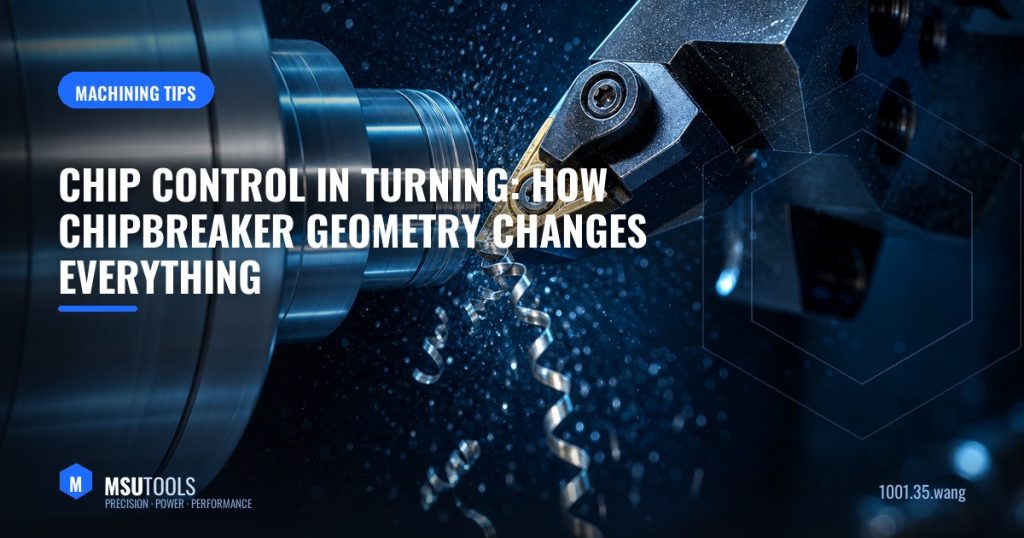
Ask any turner what ruins an otherwise good process and long stringy chips will be near the top of the list. They wrap around the tool and the part, scratch finished surfaces, jam conveyors, and make unattended running impossible. Chip control is not a cosmetic issue — it decides whether a process can run reliably.
How a Chipbreaker Actually Works
A chipbreaker is the moulded topography on the rake face of an insert: a land, a groove and a raised bump or wall. As the chip forms it flows up the rake face, hits the geometry, and is forced to curl. Once curled tightly enough, the chip work-hardens and fractures under its own bending stress — either against the workpiece, against the tool flank, or simply from its own curl.
Break it too little and you get bird’s nests. Break it too aggressively and you waste power, generate heat and can chip the cutting edge.
The Chip Control Window
Every chipbreaker has a working window defined by feed rate and depth of cut. Inside the window, chips break into comfortable 6-shapes or short commas. Outside it, they either come off long and stringy (feed too low) or become very short and burn power (feed too high).
| Chipbreaker type | Typical feed (mm/rev) | Typical DOC (mm) | Use |
|---|---|---|---|
| Finishing (F) | 0.05–0.25 | 0.3–2.0 | Light cuts, best finish |
| Medium (M) | 0.15–0.45 | 1.0–4.0 | General purpose |
| Roughing (R) | 0.30–0.80 | 2.5–8.0 | Heavy stock removal |
The single most common mistake is using a roughing chipbreaker at finishing feeds. The geometry needs a thick chip to work against; at 0.1 mm/rev the chip simply slides over the breaker without curling and comes off as continuous wire.
Material Changes the Rules
Steel (P)
Generally cooperative. Standard chipbreakers work across a broad window and chips break predictably.
Stainless Steel (M)
The difficult one. Austenitic stainless is ductile and work-hardens, producing tough, springy chips that resist breaking. Use a dedicated stainless chipbreaker with a sharper, more open geometry, keep the feed up, and avoid dwelling — never let the tool stop while still in contact with the surface, or you will work-harden a layer the next pass has to fight through.
Cast Iron (K)
Produces short, powdery chips naturally. Chip control is not the problem here; abrasion resistance is.
Aluminium (N)
Very ductile and prone to long chips and built-up edge. Use high-positive polished inserts with an open, sharp geometry and generous coolant.
Titanium and Superalloys (S)
Chips are tough and carry a lot of heat. High-pressure coolant aimed at the rake face is the most effective chip-breaking tool available — it hydraulically forces the chip to curl and break.
Reading Your Chips
Chips are the best real-time diagnostic in machining. Learn to read them:
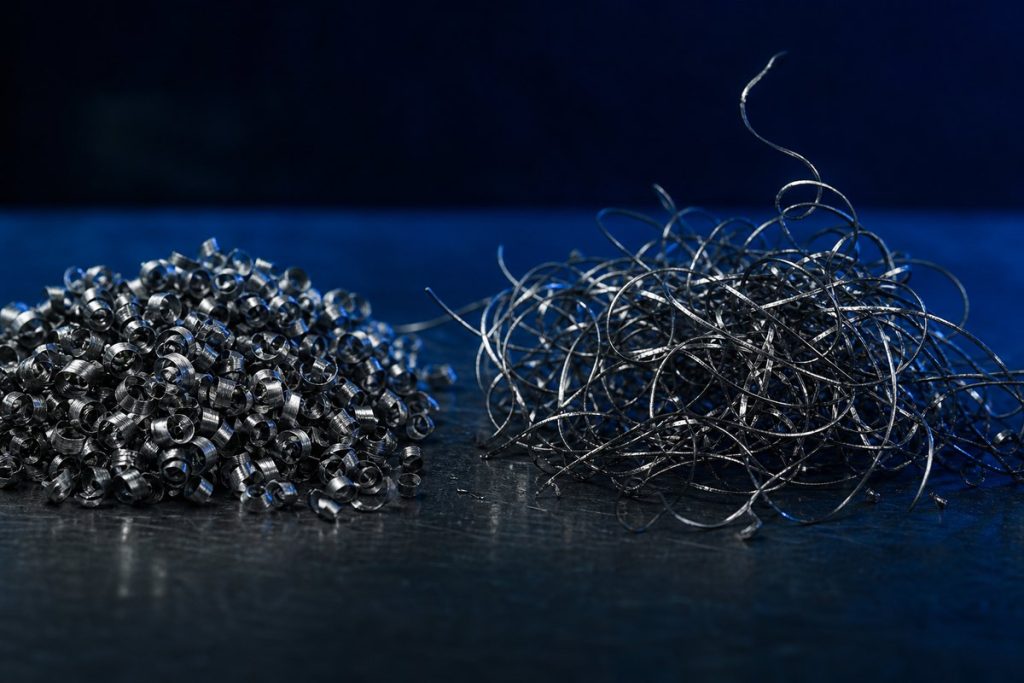
- Long stringy spirals — feed too low, or wrong chipbreaker for the operation.
- Tight 6s and 9s, silver or light straw — ideal.
- Very short fragments, dark blue or purple — too much heat; reduce speed or improve coolant delivery.
- Chips welding to the insert — built-up edge; increase speed or change to a sharper, more positive geometry.
- Chips hitting the finished surface — adjust lead angle or coolant direction; this is a finish killer.
Practical Adjustments, In Order
- Raise the feed first. It is the strongest lever on chip breaking and usually improves productivity at the same time.
- Increase depth of cut if the setup allows — a thicker chip breaks more readily.
- Change the chipbreaker to one whose window matches your actual cutting data.
- Adjust the corner radius. A smaller radius directs the chip better in light cuts.
- Aim the coolant at the rake face, not just the general area.
Our turning insert range is offered in finishing, medium and roughing chipbreakers for each ISO material group, so the geometry can be matched to the cut rather than compromised.
Need Help Choosing?
MSU Tools manufactures the full range of solid carbide and indexable tooling discussed above. Tell us your material, machine and application, and our engineering team will recommend the optimal tool and grade — or design a custom solution to your drawing. Contact our engineers for a same-day technical reply.
Questions about this topic?
Our engineers are happy to advise on tools, grades and cutting parameters.