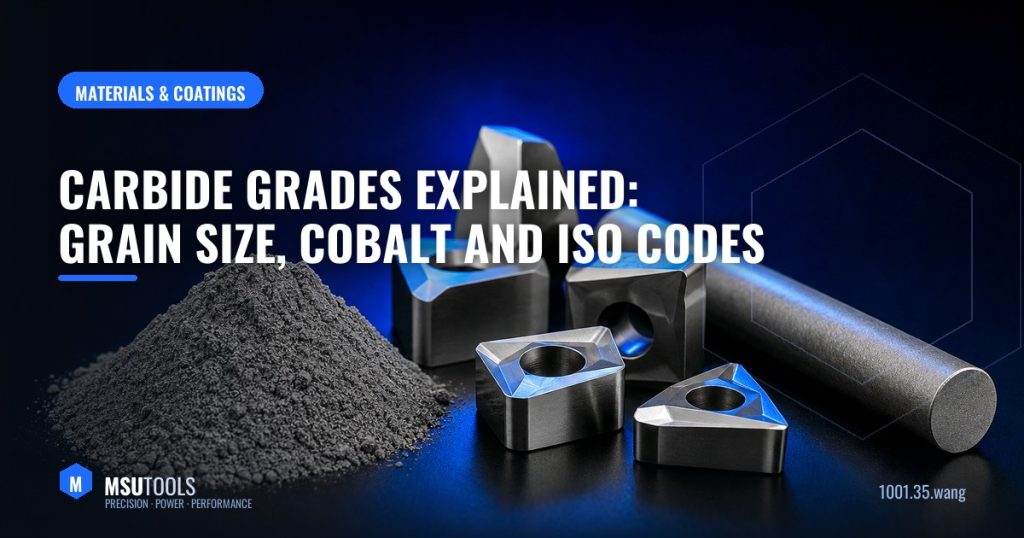
Two end mills can share the same diameter, flute count, geometry and coating and still deliver very different tool life. The difference is the carbide itself — a composite whose properties are set long before the tool is ground.
What Cemented Carbide Actually Is
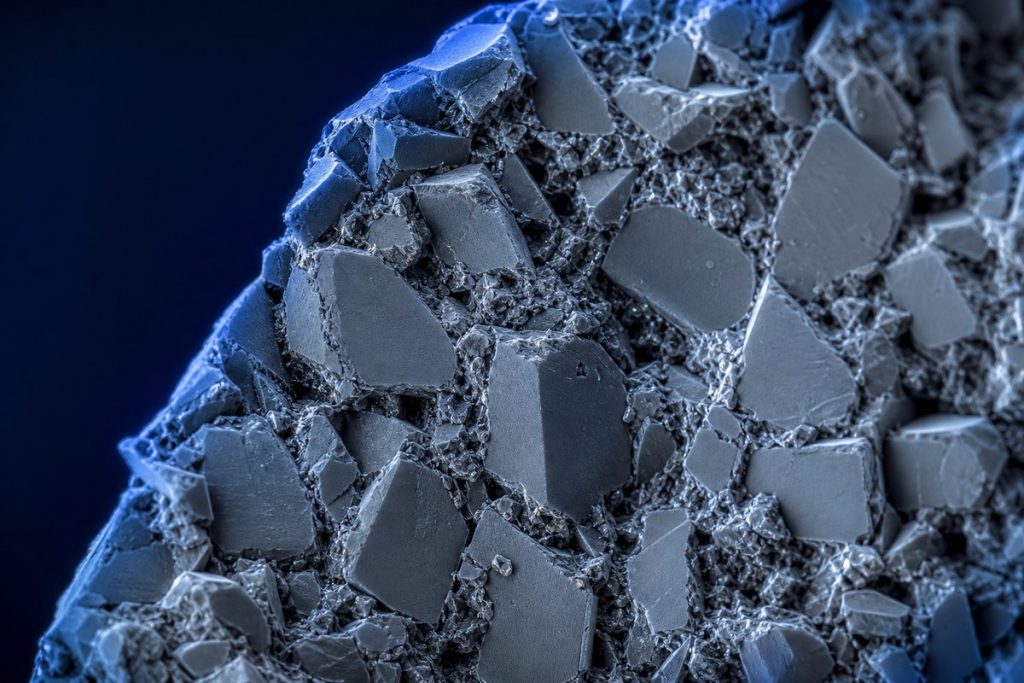
Cemented carbide is tungsten carbide (WC) grains held together by a metallic binder, almost always cobalt. The tungsten carbide provides hardness and wear resistance; the cobalt provides toughness and stops the tool shattering.
Everything about a grade’s behaviour comes from two variables: how big the WC grains are and how much cobalt binds them.
Grain Size
| Classification | Grain size | Character | Typical use |
|---|---|---|---|
| Ultra-fine | < 0.5 µm | Very hard, holds a keen edge | Micro tools, finishing, hardened steel |
| Sub-micron | 0.5–0.8 µm | Excellent balance | Most solid carbide end mills and drills |
| Fine | 0.8–1.3 µm | Good general purpose | General milling and turning |
| Medium | 1.3–2.5 µm | Tougher, less hard | Roughing, interrupted cuts |
| Coarse | > 2.5 µm | Very tough, impact resistant | Mining, heavy interrupted work |
Smaller grains mean a sharper, more wear-resistant edge — which is why micro tools and hard-milling cutters use ultra-fine substrates. Larger grains absorb shock better.
Cobalt Content
Typically 6–15% by weight, and it is a direct trade-off:
- Low cobalt (6–8%) — harder, more wear resistant, better hot hardness. Best for finishing, hardened materials and stable setups. More prone to chipping if the setup is poor.
- Medium cobalt (8–12%) — the general-purpose range for most solid carbide tooling.
- High cobalt (12–15%) — tougher and more impact resistant, but wears faster and softens sooner. For heavy interrupted cuts and unstable conditions.
A useful mental model: hardness resists wear, toughness resists breakage, and you cannot maximise both. Choosing a grade is choosing which failure mode you would rather manage.
The ISO Application Codes
Indexable inserts are classified by the material they are designed to cut, with a colour code you will see on every box:
| Code | Colour | Material group |
|---|---|---|
| P | Blue | Steel — carbon, alloy, tool steels |
| M | Yellow | Stainless steel — austenitic, duplex |
| K | Red | Cast iron — grey, ductile, malleable |
| N | Green | Non-ferrous — aluminium, copper, plastics |
| S | Brown | Superalloys and titanium |
| H | Grey | Hardened materials, HRC45+ |
Each letter is followed by a number, typically 01–50. Lower numbers mean harder and more wear resistant; higher numbers mean tougher. So P10 is a finishing grade for steel, while P40 is a roughing grade for interrupted cuts in the same material.
Reading a Grade in Practice
Given the code P25, you know: designed for steel, mid-range between wear resistance and toughness — a sensible general-purpose choice for medium turning. If you are getting flank wear too quickly, move toward P15. If you are chipping edges, move toward P35.
That single adjustment — moving along the number scale in the direction your wear pattern indicates — solves a large proportion of tool life problems without changing anything else.
Substrate and Coating Work Together
A hard coating on a substrate that flexes will crack and spall. A tough substrate under a coating chosen for the wrong material wears out regardless. That is why grades are developed as a system: substrate, edge preparation and coating specified together for a defined application window.
When you compare suppliers, compare the system — not just the coating colour on the box.
We control grain size, cobalt content, edge preparation and coating in-house across our complete tooling range, and can develop a specific grade for a demanding application. Talk to our engineers about your material.
Talk to Our Engineers
MSU Tools manufactures the full range of solid carbide and indexable tooling discussed here. Tell us your material, machine and application and we will recommend the optimal tool, grade and starting parameters — or design a custom tool to your drawing. Send us your requirement for a reply within one business day.
Questions about this topic?
Our engineers are happy to advise on tools, grades and cutting parameters.