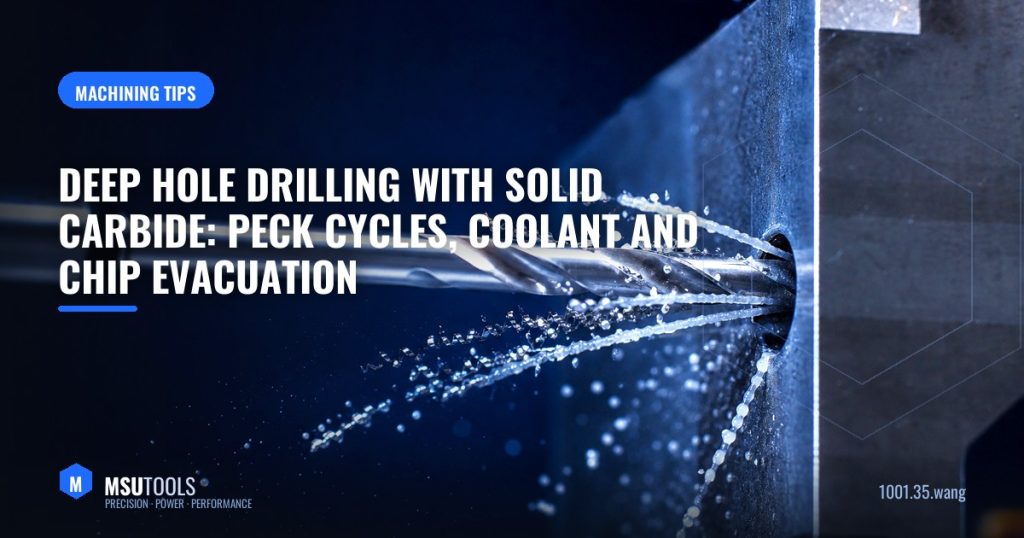
A solid carbide drill cutting a 3×D hole is a straightforward operation. The same drill geometry at 15×D is an entirely different engineering problem. Past roughly five diameters deep, the limiting factor stops being how well the tool cuts and becomes how reliably chips get out of the hole.
Why Depth Changes Everything
Three things work against you as the hole gets deeper:
- Chip evacuation distance. Every chip must travel the full hole depth along the flute. The longer the journey, the greater the chance of packing.
- Coolant delivery. Getting fluid to the cutting edge against outgoing chips becomes progressively harder.
- Drill rigidity. Stiffness falls with the cube of unsupported length, so deviation and vibration grow quickly.
When chips pack in the flutes, torque spikes almost instantly and the drill snaps. Nearly every broken deep-hole drill is a chip evacuation failure, not a wear failure.
Start With a Good Pilot
Beyond about 5×D, a pilot hole is not optional. Use a spotting drill or a short pilot drill of the same diameter, drilled to about 1.5×D depth. Two rules matter:
- The pilot must be the same nominal diameter or very slightly larger — never smaller, which would make the deep drill’s corners cut on entry.
- The pilot drill’s point angle should be equal to or slightly steeper (larger included angle) than the deep drill, so the deep drill’s centre contacts first and self-centres.
Peck Strategy
Modern through-coolant carbide drills need far less pecking than older HSS practice suggests. Excessive pecking wastes cycle time and, worse, re-entry shock can chip the edge.
| Depth | Recommended strategy |
|---|---|
| Up to 5×D | Single pass, no peck (with through coolant) |
| 5–8×D | Single pass, or one full retract at mid-depth |
| 8–12×D | Chip-breaking pecks of 2–3×D |
| 12×D and beyond | Full retract pecks of 1.5–2×D to clear flutes completely |
Distinguish the two peck types. A chip-breaking peck retracts only a fraction of a millimetre — just enough to interrupt the chip — and keeps the drill in the hole. A full retract peck withdraws the drill completely so flutes can clear and coolant can flush. Deep holes need the latter.
Coolant Is the Whole Game
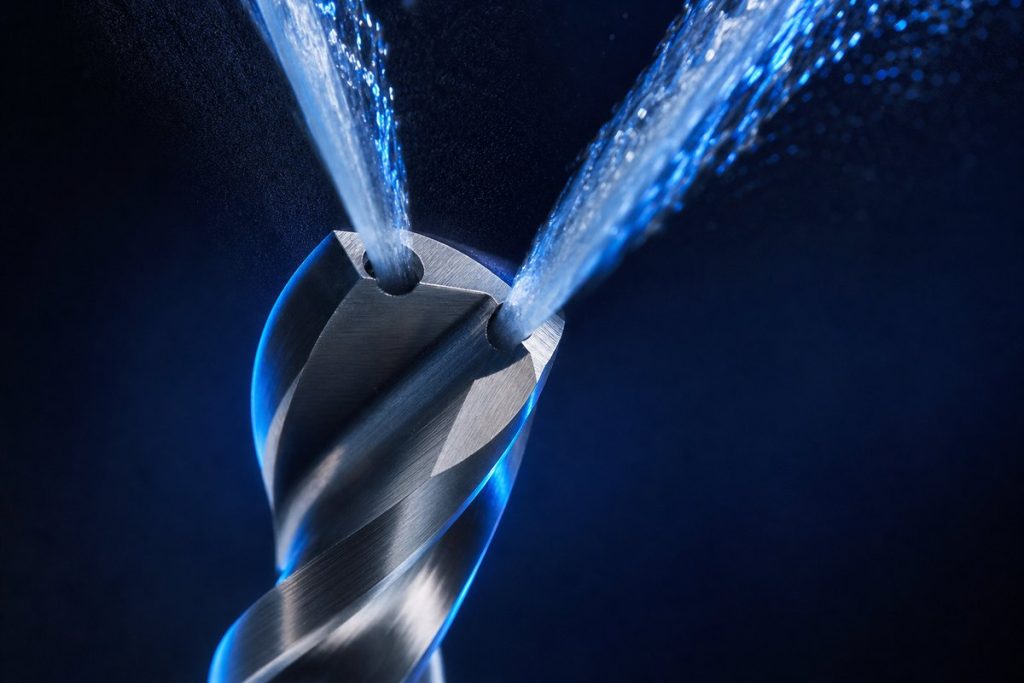
Through-tool coolant is effectively mandatory beyond 5×D. Target pressures:
- Up to 8×D — 20–30 bar
- 8–15×D — 40–70 bar
- Beyond 15×D — 70 bar and above
Concentration matters too: a 8–10% emulsion provides the lubricity needed to keep chips sliding rather than sticking. Watch the chips coming out of the hole — steady, consistent evacuation means the process is stable. If flow becomes intermittent, stop before the drill decides for you.
Cutting Data Adjustments
Reduce feed as depth increases, but never reduce it to the point of rubbing:
| Depth | Feed adjustment | Speed adjustment |
|---|---|---|
| 3×D | 100% | 100% |
| 5×D | 90% | 95% |
| 8×D | 80% | 90% |
| 12×D | 70% | 80% |
| 16×D+ | 55–65% | 70% |
Entry and Exit Discipline
- Reduce feed for the first 0.5 mm to about 50% while the point establishes itself.
- Start coolant before the drill touches — never enter a dry hole.
- Reduce feed at breakthrough to roughly 50% to prevent the corners chipping as the drill exits.
- Retract with the spindle running and coolant on, so the flutes flush on the way out.
Diagnosing Failures
- Drill snapped mid-hole — chip packing; increase peck frequency and coolant pressure.
- Hole drifting off position — inadequate pilot, or too much runout at entry.
- Chipped corners — breakthrough feed too high, or the material has hard inclusions.
- Oversized hole — runout above 10 µm; check the holder before blaming the drill.
- Squealing noise — the drill is rubbing; the feed is too low.
Our solid carbide drill range covers 3×D through 30×D, including through-coolant deep-hole and micro drilling geometries.
Need Help Choosing?
MSU Tools manufactures the full range of solid carbide and indexable tooling discussed above. Tell us your material, machine and application, and our engineering team will recommend the optimal tool and grade — or design a custom solution to your drawing. Contact our engineers for a same-day technical reply.
Questions about this topic?
Our engineers are happy to advise on tools, grades and cutting parameters.