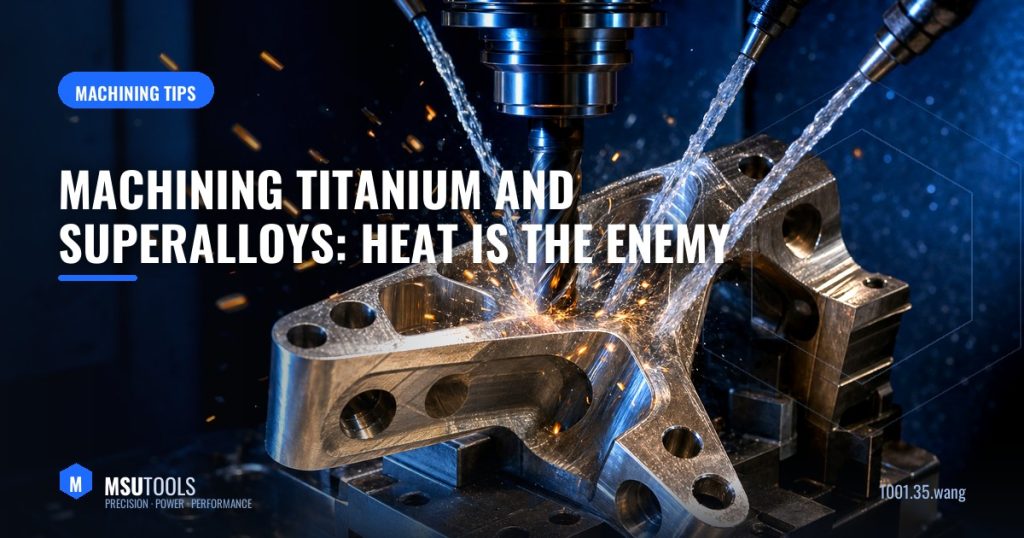
Ti-6Al-4V has a hardness around HRC36 — softer than plenty of tool steels that machine easily. Yet it is one of the most demanding materials in the shop. The problem is not hardness; it is where the heat goes.
Why Titanium Is Hard on Tools
- Very low thermal conductivity. About one seventh that of steel, so heat cannot escape in the chip and concentrates in the cutting edge.
- Chemical reactivity. At cutting temperatures titanium reacts with most tool materials, so the tool is chemically attacked as well as mechanically worn.
- Low modulus of elasticity. The workpiece flexes away from the tool and springs back, causing rubbing and chatter in thin sections.
- A narrow segmented chip. Chips form in shear bands, producing a cyclic load that fatigues the cutting edge.
Nickel superalloys such as Inconel 718 add extreme work hardening and abrasive carbide particles to that list.
Cutting Data — Slow and Steady
| Material | Surface speed (m/min) | Feed per tooth (mm) |
|---|---|---|
| Ti-6Al-4V, roughing | 40–70 | 0.08–0.15 |
| Ti-6Al-4V, finishing | 60–100 | 0.05–0.10 |
| Inconel 718, roughing | 20–35 | 0.08–0.12 |
| Inconel 718, finishing | 30–50 | 0.05–0.08 |
Note the pattern: speed is low, but feed is not. Feed per tooth stays comparable to steel machining, because a thin chip in these materials means rubbing, and rubbing means work hardening.
Coolant Strategy
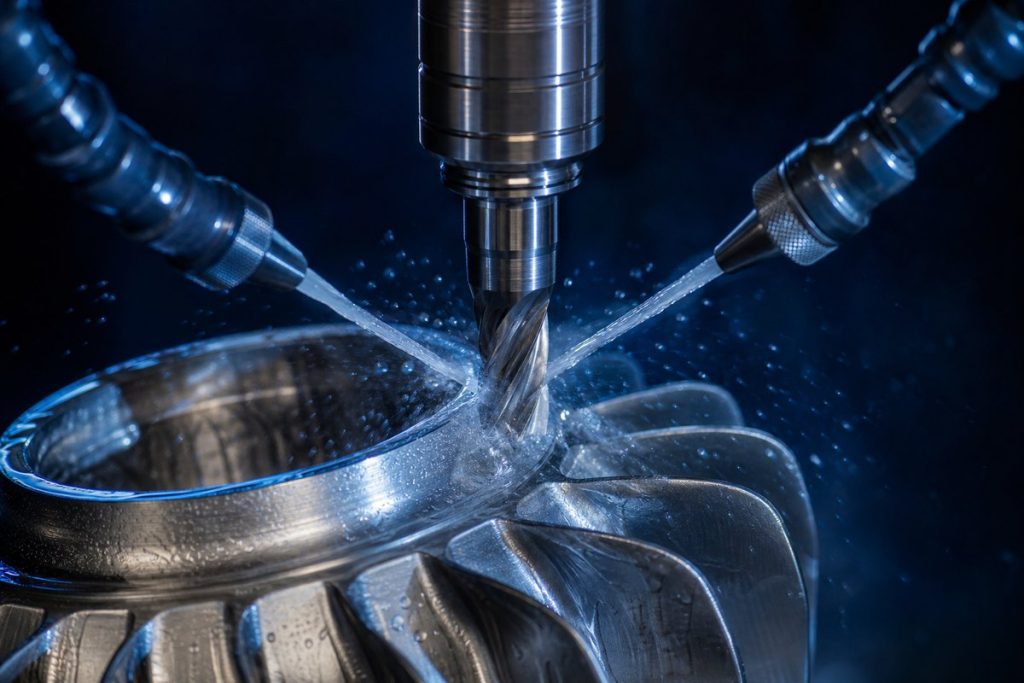
In titanium, coolant is not a lubricant — it is the heat-removal system, and its delivery matters more than its chemistry.
- High pressure is transformative. 70 bar directed at the cutting edge can double tool life over standard flood, because it penetrates the vapour barrier that forms at the interface.
- Aim precisely. Coolant in the general area achieves very little; it must reach the edge.
- Never machine titanium dry in production. Beyond tool life, titanium fines are a genuine fire hazard.
- Use through-tool delivery wherever the tool offers it.
Tool Selection
- Grade: ISO S. Fine grain, tough substrate with good hot hardness.
- Coating: TiAlN or AlTiN. Avoid pure TiN — it lacks the heat resistance.
- Geometry: sharp positive rake to reduce cutting forces and heat generation; a honed rather than knife-sharp edge for stability.
- Flute count: more flutes (5–7) for finishing to lower the load per tooth; fewer for roughing to leave chip space.
- Helix: high helix cuts more freely and reduces heat.
Strategy Matters More Than Data
- Climb mill. Conventional milling starts each tooth with a rubbing action — fatal here.
- Keep the tool moving. Any dwell instantly work-hardens and burns the edge.
- Use constant-engagement toolpaths. Avoid full-width corners where engagement suddenly doubles.
- Arc in and out of cut. The segmented chip already cycles the load; do not add shock entries.
- Change tools on a schedule. A worn tool generates more heat, which accelerates wear — the failure is exponential, and it usually takes the part with it.
Rigidity and Fixturing
Because titanium has a low modulus, thin walls deflect and spring back into the tool. Support the part properly, take lighter radial cuts on thin features, and consider a stepped approach that leaves stock for a final light pass on a fully supported wall.
Our S-grade drills and titanium end mills are supplied with through-coolant options and AlTiN coatings selected for these alloys.
Talk to Our Engineers
MSU Tools manufactures the full range of solid carbide and indexable tooling discussed here. Tell us your material, machine and application and we will recommend the optimal tool, grade and starting parameters — or design a custom tool to your drawing. Send us your requirement for a reply within one business day.
Questions about this topic?
Our engineers are happy to advise on tools, grades and cutting parameters.