Stainless steel is not especially hard, yet it defeats more tools than materials twice its hardness. The reasons are its toughness, its poor thermal conductivity and — above all — its tendency to work-harden the instant a tool stops cutting properly.
Why Austenitic Stainless Is Difficult
- It work-hardens rapidly. Deformation transforms the surface layer into a much harder skin. Rub it once and the next pass has to cut through that skin.
- It conducts heat poorly. Around a third as well as carbon steel, so heat concentrates at the cutting edge instead of leaving in the chip.
- It is gummy. High ductility means long stringy chips and a strong tendency to weld to the tool.
- Chromium oxide is abrasive. The layer that makes it stainless also accelerates flank wear.
The Golden Rule: Never Dwell, Never Rub
Every practical stainless rule follows from one principle — the tool must always be taking a real chip.
- Never let the tool stop while touching the workpiece.
- Never spring-pass with almost no depth of cut. Take at least 0.3 mm, ideally more.
- Never reduce feed when things sound rough — reduce speed instead.
- Never re-cut over the same surface without removing meaningful material.
A too-light cut is worse than a too-heavy one in stainless. The tool burnishes rather than cuts, hardens the surface, and the next tooth arrives at a harder material with a hotter edge.
Cutting Data
| Operation | Surface speed (m/min) | Feed per tooth (mm) |
|---|---|---|
| Milling, roughing | 80–120 | 0.08–0.15 |
| Milling, finishing | 100–150 | 0.05–0.10 |
| Turning, roughing | 120–180 | 0.25–0.40 mm/rev |
| Turning, finishing | 150–220 | 0.10–0.20 mm/rev |
| Drilling | 25–45 | 0.05–0.20 mm/rev |
These are roughly 60–70% of the speeds you would use in mild steel, with feeds kept deliberately generous.
Fighting Built-Up Edge
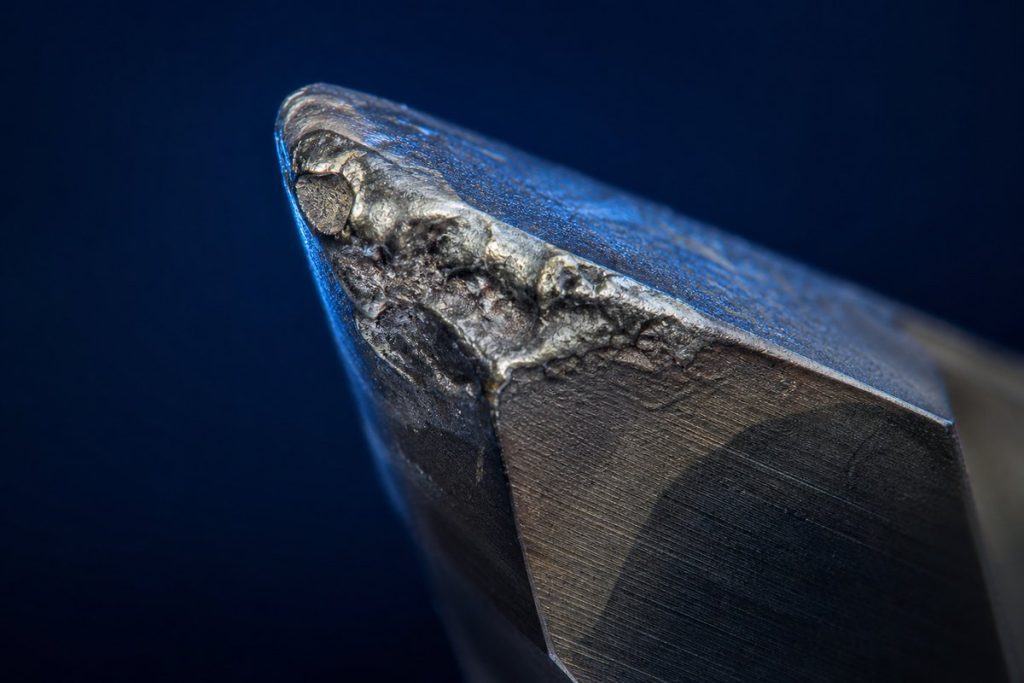
Built-up edge forms when workpiece material cold-welds to the rake face. It changes the effective geometry, ruins surface finish, and when it eventually breaks away it tears fragments of carbide with it.
To prevent it:
- Use a sharp, positive rake geometry. Stainless-specific chipbreakers are more open and sharper than steel grades.
- Increase cutting speed. BUE forms in a low-speed window; running faster often eliminates it entirely.
- Use a polished or smooth-coated tool. A rough rake face gives the material something to key into.
- Deliver plenty of coolant with good lubricity — 8–10% emulsion, aimed at the rake face.
Tool Selection
- Grade: an ISO M grade with a tough substrate; stainless produces high edge loads and needs resistance to plastic deformation.
- Coating: TiAlN for milling and turning. Avoid excessively thick coatings that dull the edge.
- Geometry: sharp positive rake, generous flute space for the long chips, and a corner radius rather than a sharp corner.
- Flute count for milling: 4 flutes for general work; anti-vibration variable pitch helps considerably.
Duplex and Super Duplex
Duplex grades are stronger and even more abrasive. Reduce speed a further 20–30%, keep feeds up, and expect shorter tool life — plan the change-out rather than running to failure, because a failed edge in duplex usually damages the part.
Our M-grade turning inserts and stainless-optimised end mills use substrates and edge preparations developed specifically for these materials.
Talk to Our Engineers
MSU Tools manufactures the full range of solid carbide and indexable tooling discussed here. Tell us your material, machine and application and we will recommend the optimal tool, grade and starting parameters — or design a custom tool to your drawing. Send us your requirement for a reply within one business day.
Questions about this topic?
Our engineers are happy to advise on tools, grades and cutting parameters.