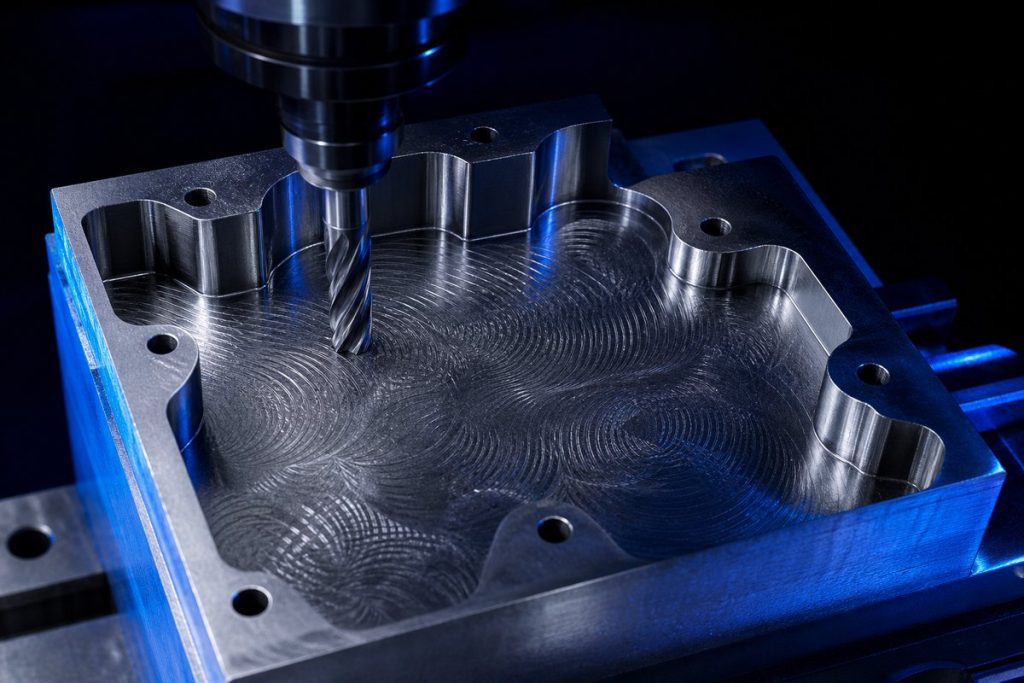
Conventional roughing takes a shallow axial depth and a wide radial width. Trochoidal — or dynamic — milling turns that upside down: a deep axial depth with a very light radial engagement, moving in overlapping circular arcs. It looks slower on paper. In practice it removes more metal per hour and often multiplies tool life several times over.
Why Light Radial Engagement Wins
Three things happen when you cut with only 5–15% of the tool diameter engaged:
- Heat is spread over the whole flute length. Using the full axial depth means every part of the cutting edge does some work instead of wearing a notch at one height.
- Each edge gets time to cool. With a small engagement angle, the tooth is out of the cut for most of each revolution.
- Cutting forces stay low and constant. The tool is never buried in a corner, so there are no sudden load spikes.
Because forces are low, you can raise feed and speed dramatically. The classic trade — deep and narrow instead of shallow and wide — usually nets a higher metal removal rate even though the chip is thinner.
Chip Thinning: The Part People Miss
Below about 50% radial engagement, the actual chip is thinner than your programmed feed per tooth. The tool is only in contact for a short arc, so the material each tooth removes is reduced. If you do not compensate, you end up rubbing instead of cutting — which destroys the edge.
The correction factor for radial engagement (ae) on a tool of diameter (D):
| Radial engagement | Chip thinning factor | Feed adjustment |
|---|---|---|
| 50% of D | 1.00 | no change |
| 25% of D | 1.15 | +15% |
| 15% of D | 1.40 | +40% |
| 10% of D | 1.67 | +67% |
| 5% of D | 2.29 | +129% |
Most modern CAM systems apply this automatically, but always verify — a trochoidal path run at unadjusted feed is the single most common reason people conclude “dynamic milling did not work for us”.
Getting the Parameters Right
Starting values for a solid carbide end mill in steel:
- Axial depth (ap): 1.5–2× the tool diameter. Use the flute length you have.
- Radial engagement (ae): 5–10% of diameter for hardened material, 10–15% for general steel.
- Surface speed: 30–60% higher than conventional roughing.
- Feed per tooth: conventional value multiplied by the chip thinning factor above.
What You Need for It to Work
- A CAM system with dynamic toolpaths — hand-programming smooth arcs is impractical.
- A machine with good look-ahead. Trochoidal paths generate thousands of short moves; an older control may starve and stutter.
- A tool with adequate flute length and, ideally, variable helix to suppress harmonics.
- Rigid tool holding. The long unsupported length is where deflection can creep in.
Where It Pays Most
Trochoidal milling shines in deep pockets, slots and hard materials — exactly the cases where conventional roughing is slowest and hardest on tools. In slotting it is transformative: a full-width slot with a conventional path buries the tool, while a trochoidal path opens the same slot with a fraction of the load.
For hardened steels above HRC50 it is often the only practical roughing strategy, because it keeps engagement small enough that the edge survives.
Common Mistakes
- Not compensating for chip thinning — the tool rubs, work-hardens the surface and burns.
- Keeping the axial depth shallow — you lose the whole benefit; go deep.
- Using a short flute tool — you cannot exploit the depth.
- Running the same speed as conventional — leaving most of the productivity on the table.
Our solid carbide end mills are available in long-flute and variable-helix designs made for exactly this kind of high-efficiency roughing.
Talk to Our Engineers
MSU Tools manufactures the full range of solid carbide and indexable tooling discussed here. Tell us your material, machine and application and we will recommend the optimal tool, grade and starting parameters — or design a custom tool to your drawing. Send us your requirement for a reply within one business day.
Questions about this topic?
Our engineers are happy to advise on tools, grades and cutting parameters.