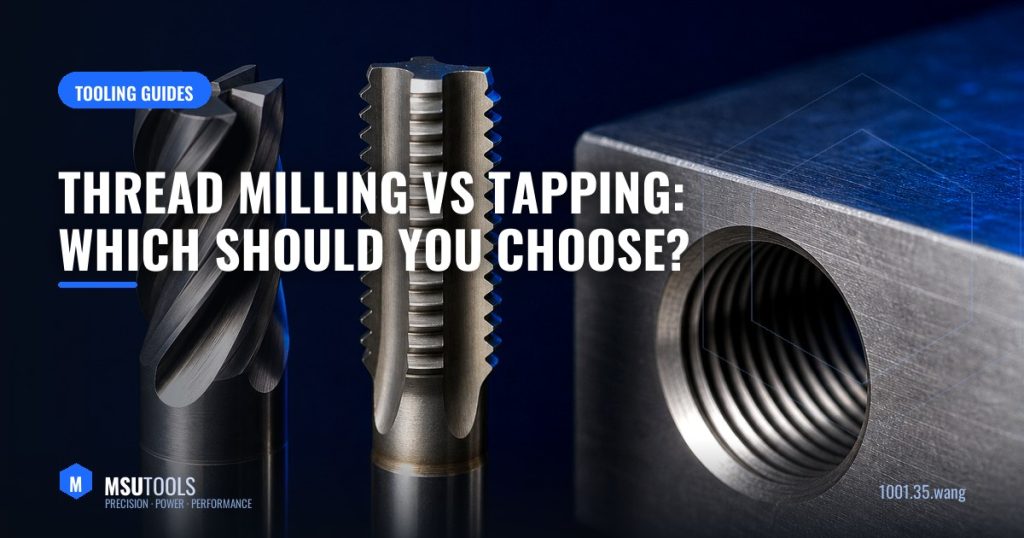
Both processes produce a thread, and both have a legitimate place in a modern shop. The decision is rarely about which is technically superior — it is about matching the process to the part, the material and the consequences of failure.
The Fundamental Difference
A tap is a forming tool the size of the thread it cuts. It enters the hole, engages fully, and is mechanically locked to the workpiece by the thread it is creating. If it breaks, it breaks inside the hole.
A thread mill is smaller than the hole. It moves in a helical interpolation, removing material progressively. It is never locked to the part, and it can be retracted at any moment.
That single structural difference drives almost every practical advantage and disadvantage on both sides.
Side by Side
| Tapping | Thread milling | |
|---|---|---|
| Cycle time per hole | Faster | Slower |
| Tool cost | Lower | Higher |
| Sizes per tool | One | Many (same pitch) |
| Right- and left-hand | Separate tools | Same tool |
| Risk if tool breaks | Severe — stuck in part | Low — retracts freely |
| Blind holes | Needs clearance at bottom | Threads very close to bottom |
| Hard materials (>HRC45) | Difficult | Practical |
| Thread size control | Fixed by tool | Adjustable by offset |
| Large threads | High torque required | Low cutting force |
| Chip control | Can pack in blind holes | Chips clear easily |
When Tapping Is the Right Choice
- High volume, small threads. For M3–M10 in mild steel or aluminium at production quantities, a tap is simply faster and cheaper per hole.
- Through holes in free-machining material. Chips exit easily and the risk is low.
- Machines without helical interpolation. Thread milling requires simultaneous three-axis motion.
- Low-value parts. If a broken tap means scrapping a $5 part, the risk calculus is very different from a $5,000 part.
When Thread Milling Wins
Expensive or Nearly Finished Parts
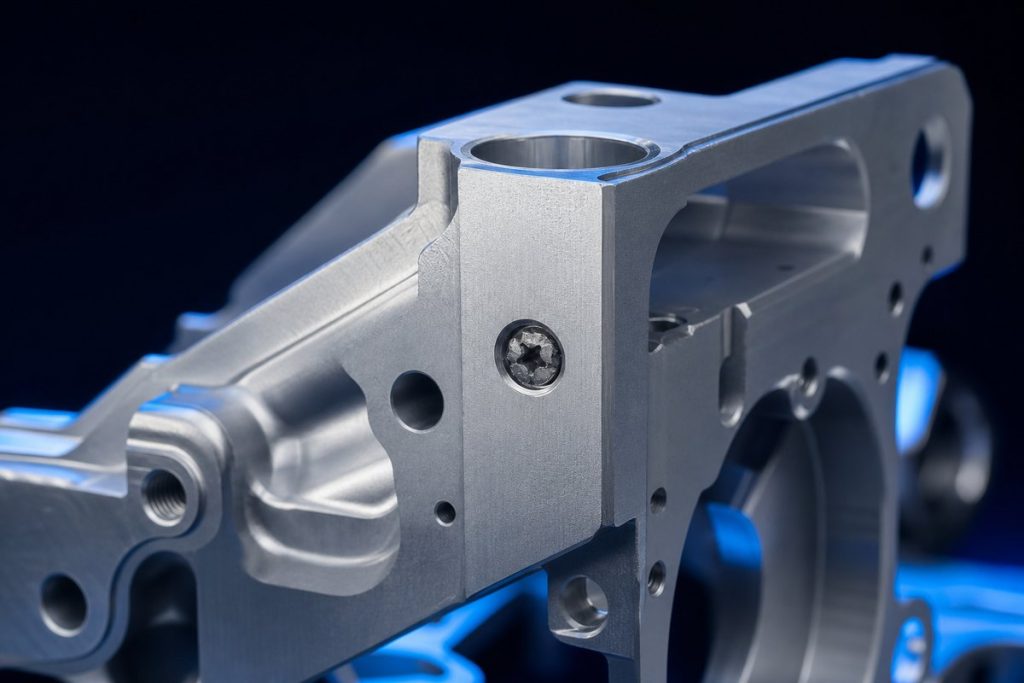
This is the strongest argument. Threading is often one of the last operations. A tap breaking in an aerospace housing or a mould base after twenty hours of machining can scrap the part entirely. A thread mill simply retracts.
Hard Materials
Above about HRC45, tapping becomes unreliable. Thread milling with a carbide tool handles hardened steel comfortably because cutting forces are much lower and chips are small.
Large Diameters
Tapping an M30 thread demands enormous torque and a rigid, powerful machine. A thread mill produces the same thread with a fraction of the force.
Blind Holes With Minimal Clearance
A tap needs run-out space at the bottom of the hole for its lead chamfer. A thread mill can thread to within roughly one pitch of the bottom.
Adjustable Fit
Because the thread is produced by interpolation, you can adjust the radial offset to tune the fit class — invaluable when a gauge shows the thread is marginally tight, or when a coating will be applied afterwards.
Tool Inventory Reduction
One thread mill of a given pitch produces every diameter that shares that pitch, in both right- and left-hand. For a job shop with varied work, this significantly reduces tooling stock.
Thread Milling Practicalities
- Climb mill for the best thread finish and tool life.
- Use an arc lead-in to the thread diameter rather than a radial plunge, to avoid a witness mark.
- Compensate for deflection. Thread mills are slender; on the first part, cut, measure with a gauge, and adjust the offset.
- Single-pass vs multi-pass. In tough materials or large threads, two or three radial passes give better accuracy and tool life than forcing a single pass.
- Watch the helix direction. Bottom-up versus top-down interpolation changes the load direction; bottom-up generally gives better results in blind holes.
A Simple Decision Rule
Ask what happens if the tool breaks. If the answer is “scrap an expensive part” or “spend two hours on EDM removal”, thread mill. If the answer is “throw away a cheap blank and carry on”, tap — and enjoy the shorter cycle time.
We manufacture solid carbide thread mills in single-profile and multi-tooth designs, alongside indexable threading inserts for external and internal turning.
Need Help Choosing?
MSU Tools manufactures the full range of solid carbide and indexable tooling discussed above. Tell us your material, machine and application, and our engineering team will recommend the optimal tool and grade — or design a custom solution to your drawing. Contact our engineers for a same-day technical reply.
Questions about this topic?
Our engineers are happy to advise on tools, grades and cutting parameters.