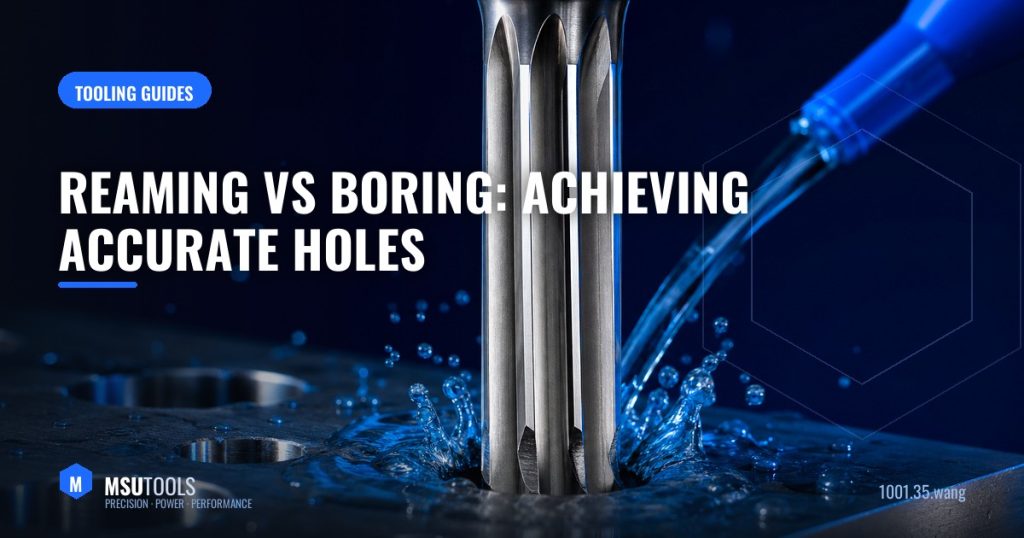
A drill makes a hole; it does not make an accurate hole. A typical solid carbide drill holds around IT9 with modest roundness and position accuracy. When the print calls for H7, a fine finish or precise position, you need a second operation — and the choice between reaming and boring decides your cycle time and your success rate.
What Each Process Gives You
| Drilling | Reaming | Boring | |
|---|---|---|---|
| Tolerance | IT9–IT11 | IT7 (H7) | IT6–IT7 |
| Surface finish (Ra) | 3.2–6.3 µm | 0.8–1.6 µm | 0.4–1.6 µm |
| Corrects position? | — | No | Yes |
| Corrects straightness? | — | No | Yes |
| Diameter flexibility | Fixed | Fixed | Adjustable |
| Speed | Fast | Fast | Slower |
The critical difference is in the middle rows. A reamer follows the existing hole. It improves size and finish but cannot correct a hole that is in the wrong place or not straight. A boring bar cuts on a single point defined by the spindle axis, so it corrects both.
Reaming Done Right
Stock Allowance
This is where most reaming problems start. Too much stock overloads the reamer; too little means it burnishes instead of cutting.
| Reamer diameter | Stock on diameter |
|---|---|
| 3–6 mm | 0.10–0.15 mm |
| 6–12 mm | 0.15–0.25 mm |
| 12–25 mm | 0.25–0.40 mm |
| 25 mm and above | 0.40–0.60 mm |
Cutting Data
Reaming runs slow and fed hard — typically one third to one half of drilling speed with two to three times the feed. A light feed causes rubbing, which glazes the surface, oversizes the hole and destroys the reamer.
Practical Rules
- Never reverse the reamer while it is in the hole — it will scratch the bore and dull the edges. Retract with the spindle still turning forward.
- Use a floating holder if the pre-hole position is not perfectly concentric with the spindle. A rigidly held reamer forced into an off-position hole will cut oversize and bell-mouthed.
- Flood the hole with coolant, preferably through the tool — chips trapped between the reamer margins and the bore cause scoring.
- Match the reamer to the material. Straight flutes for through holes, left-hand spiral to push chips forward, right-hand spiral to pull chips back in blind holes.
When to Bore
Choose boring when:
- The position must be corrected — reaming will faithfully reproduce your drill’s error.
- The diameter is non-standard and no reamer exists.
- The hole is large, where a reamer would be expensive and unwieldy.
- You need very tight tolerance (IT6) or an exceptional finish.
- The bore is interrupted by a slot or cross-hole, which would deflect a reamer.
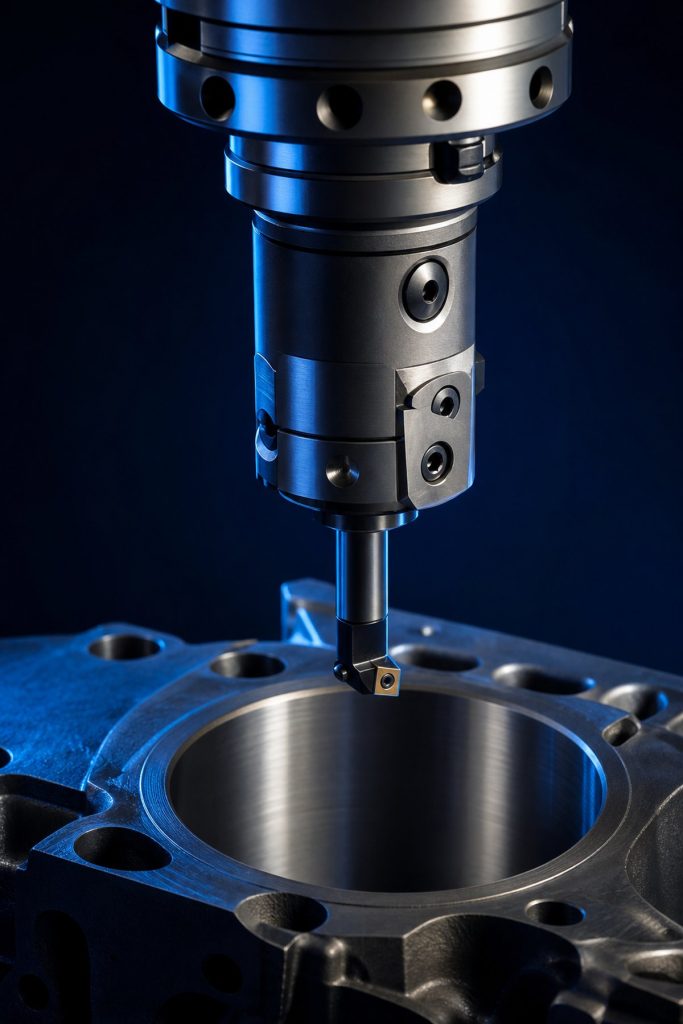
A modern adjustable boring head resolves to a few microns on diameter, so you can dial in exactly the fit you need — invaluable when a gauge shows you are marginally out.
A Reliable Sequence for H7
- Spot drill to establish position.
- Drill undersize, leaving the correct reaming stock.
- Bore if position or straightness needs correcting.
- Ream to final size with correct speed and feed.
- Check with a plug gauge, not just a caliper — a caliper cannot tell you the hole is round.
We manufacture solid carbide reamers and precision drills in standard and custom sizes, including H7 tolerances to your drawing. Send us your requirement.
Talk to Our Engineers
MSU Tools manufactures the full range of solid carbide and indexable tooling discussed here. Tell us your material, machine and application and we will recommend the optimal tool, grade and starting parameters — or design a custom tool to your drawing. Send us your requirement for a reply within one business day.
Questions about this topic?
Our engineers are happy to advise on tools, grades and cutting parameters.